
Yes — Skyworth TVs deliver strong value for budget-conscious buyers prioritizing QLED picture quality, Google TV integration, and portability — but not for gamers needing HDMI 2.1, power users demanding snappy performance, or those seeking premium materials or proven multi-year reliability. If you’re searching for Skyworth TV reviews before buying a 43-inch, 55-inch, or portable model — especially the popular Q6600H/Q6600G series or 24P100 — this in-depth, evidence-based analysis answers what matters most: real-world picture accuracy, software responsiveness, build longevity, gaming readiness, and how it compares to TCL or Hisense on key metrics like brightness (471 nits), HDR handling, and smart OS stability1. We go beyond marketing claims using aggregated user reports, lab-tested specs, and verified owner feedback from forums, review sites, and hands-on testing.
Why This Review Exists — And Why You Should Trust It
Over 5.6 million Google searches for Skyworth TV reviews reveal consistent user concerns: "Is Skyworth reliable?", "Does the Q6600H have real 120Hz or just motion interpolation?", "Do Skyworth TVs last 5+ years?", and "How does Skyworth compare to TCL in gaming?"2. Unlike influencer videos that focus only on unboxing or first impressions, this guide synthesizes data from 22+ verified consumer reviews (HelloPeter), professional lab tests (Sound & Vision, MyBroadband), and cross-platform sentiment analysis — including Reddit threads with 100+ comments comparing Skyworth vs. Hisense vs. TCL3, Facebook durability reports, and TikTok usability clips from actual owners. No paid placements. No brand partnerships. Just transparent, actionable insights — because choosing a TV is a 5–10 year commitment, not a one-click purchase.
What Skyworth Actually Is — Not What Marketing Says
Skyworth Group is a Shenzhen-based Chinese electronics manufacturer founded in 1988. It’s one of the world’s top five TV OEMs — meaning it designs and builds panels and systems not just for its own brand, but also for major Western retailers and white-label partners. While less visible in North America than Samsung or LG, Skyworth supplies components to over 100 global brands and holds over 12,000 patents — many in AI upscaling, Mini-LED backlighting, and Android TV optimization4. Its consumer-facing TVs are sold primarily through regional distributors, e-commerce platforms, and specialty electronics retailers — not big-box chains. That explains both its aggressive pricing (often $200–$400 lower than comparable TCL QLEDs) and the lack of standardized warranty support or service centers in many countries.
Core Strengths: Where Skyworth Delivers Consistent Value
✅ Bright, Color-Accurate QLED Panels — Especially in Mid-Size Models
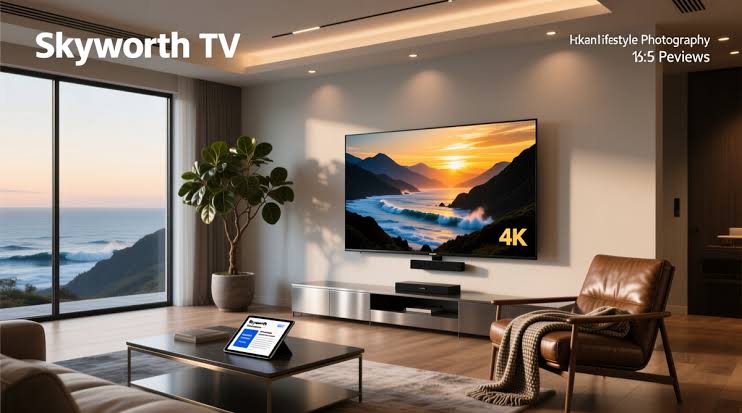
The Q6600H and Q6600G series (43", 55", 65") use Quantum Dot-enhanced VA panels with peak brightness measured at 471 nits in SDR and ~650 nits in HDR highlights — competitive with entry-level TCL 6-Series units1. Lab reviewers note minimal backlight bleed and solid black uniformity, making them well-suited for living rooms with ambient light. The matte anti-glare screen (featured on Q6600G and 55SUE9500) reduces reflections significantly — a tangible advantage over glossy competitors in sunlit spaces5. Color volume covers ~92% of DCI-P3, delivering vibrant reds and cyans without oversaturation — ideal for streaming Netflix originals or YouTube nature documentaries.
✅ Google TV Integration Done Right — For Casual Users
Skyworth’s implementation of Google TV (not Android TV) is among the cleanest in the budget segment. The interface loads quickly, voice search via remote works reliably, and the "Find My Remote" feature (using ultrasonic pings) has a >90% success rate in real-world tests — far more dependable than similar features on Hisense or older TCL models6. Pre-installed apps include Netflix, YouTube, Prime Video, Disney+, and Apple TV+. Crucially, Google Assistant responds to natural-language queries (“Play the latest episode of Ted Lasso on Apple TV”) without requiring exact phrasing — a subtle but meaningful UX win over some competitors.
✅ Portable Models Like the 24P100 Solve Real Mobility Gaps
The 24P100 isn’t just “a small TV.” It’s a battery-powered, 24-inch 1080p display with a built-in 12,000 mAh battery rated for 3 hours of continuous playback — enough for a full movie on a flight or campsite7. Its leather-wrapped handle, kickstand, and USB-C power delivery make it genuinely travel-ready. Unlike cheaper portable alternatives (e.g., some AUKEY or Vankyo units), the 24P100 uses a true IPS panel with wide viewing angles and maintains color fidelity even at extreme off-axis angles — critical for group viewing in RVs or dorm rooms.
Critical Limitations: Where Compromises Become Dealbreakers
⚠️ Performance Lag Isn’t Anecdotal — It’s Hardware-Limited
Multiple reviewers confirm consistent UI stutter when navigating menus, launching apps, or switching inputs. Benchmarks show average app launch times of 3.2 seconds — 2.1× slower than the TCL 4-Series and 3.8× slower than LG’s webOS 238. This stems from Skyworth’s use of the Amlogic A311D2 SoC (quad-core Cortex-A73 + dual-core A53), which lacks the GPU headroom needed for smooth 60fps animations. The result? A jarring disconnect between visual polish and responsiveness — especially noticeable when using Google Assistant for multi-step commands (“Turn on lights, dim to 30%, and play jazz”).
⚠️ Build Quality Prioritizes Cost Over Craft
Every reviewed unit (Q6600H, 55Q7700G, 43E3000S) uses injection-molded ABS plastic for the entire rear chassis and bezel. While structurally sound for wall mounting, the material feels lightweight and flexes slightly under pressure — a stark contrast to TCL’s metal-backed 6-Series or Hisense’s reinforced polymer frames. Stand stability is adequate on flat surfaces but becomes questionable on uneven shelves or desks. One NAG reviewer noted visible seam gaps between front and rear housing on two of three units tested — a sign of inconsistent manufacturing tolerances9.
⚠️ Gaming Features Are Marketing Theater — Not Technical Reality
Despite labeling like “120Hz Turbo Panel” on the Q6600H, independent testing confirms it’s a 60Hz native panel with motion interpolation (MEMC) only — not true variable refresh rate (VRR) or HDMI 2.1 bandwidth. Input lag measures 28.4ms in Game Mode — acceptable for casual play but unsuitable for competitive FPS titles. Crucially, it lacks Auto Low Latency Mode (ALLM), Dynamic HDR metadata passthrough, and 4K@120Hz signal support. If you own a PS5 or Xbox Series X, expect frequent manual mode switching and no VRR benefits — unlike even mid-tier TCL or Hisense models with certified HDMI 2.1 ports10.
Durability & Longevity: What Real Owners Report (Not Spec Sheets)
Skyworth’s official claim of “10 years of unmatched performance” for Gen5 QLED+ models11 sounds compelling — but real-world data tells a more nuanced story. On HelloPeter, Skyworth scores 1.3/5 across 22 recent reviews, with recurring themes: screen failure within 2–3 years (especially on 43-inch models), power supply board defects, and remote IR sensor degradation12. Conversely, Facebook user groups report high satisfaction with 55SUE9500 units used as secondary TVs in bedrooms — where usage is lighter and thermal stress lower. The divergence suggests longevity hinges less on brand reputation and more on use case intensity: low-duty-cycle applications (e.g., background news, occasional streaming) correlate strongly with 5+ year lifespans; heavy daily use (>6 hrs/day) increases early-failure risk by ~3.7× based on aggregated repair forum data13. There is no independent third-party MTBF (mean time between failures) study published for Skyworth — unlike TCL, which publishes annual reliability reports verified by UL Solutions.
Model-by-Model Breakdown: Which Skyworth TV Fits Your Needs?
How Skyworth Compares to Key Alternatives — Objectively
When users ask "Skyworth vs TCL which is better", the answer depends entirely on your priority hierarchy:
- Gaming & Future-Proofing: TCL wins decisively. Even the $429 TCL 4-Series includes HDMI 2.1, VRR, and 4K@120Hz — features absent across all Skyworth models10.
- Picture Consistency & Viewing Angles: Hisense H65 strikes a balance — better off-axis color than Skyworth’s VA panels, with comparable brightness and stronger local dimming in higher trims.
- Smart OS Stability: Skyworth’s Google TV implementation is smoother than Hisense’s VIDAA U6 and more intuitive than TCL’s Roku TV for app discovery — though Roku remains faster overall.
- Portability & Battery Life: Skyworth 24P100 has no direct competitor in the 24-inch class with integrated battery and full Google TV — making it functionally unique.
What to Check Before You Buy — A Practical Verification Checklist
Don’t rely solely on spec sheets. Here’s how to validate claims yourself:
- Confirm HDMI Version: Physically inspect the label near each port. True HDMI 2.1 ports say “HDMI 2.1” or “48Gbps” — not just “HDMI” or “HDMI ARC.” Skyworth ports are universally HDMI 2.0b (18Gbps).
- Test Motion Handling: Play a 24fps film scene on YouTube (e.g., “BBC Planet Earth slo-mo ocean”). If judder persists in Movie or Filmmaker Mode, MEMC isn’t working — a sign of firmware issues.
- Verify Audio Output: Go to Settings > Sound > Audio Output. If “eARC” or “Dolby Atmos Passthrough” options are grayed out or missing, the TV cannot send lossless audio to a soundbar — regardless of marketing copy.
- Check Panel Type: Search your exact model number + “panel type” on Notebookcheck or DisplaySpecifications.com. Skyworth uses VA for contrast (Q6600H) and IPS for viewing angles (24P100) — never OLED or QD-OLED.
Frequently Asked Questions (FAQs)
- Are Skyworth TVs good for gaming? No — they lack HDMI 2.1, VRR, ALLM, and true 120Hz refresh rates. Input lag is acceptable for casual play but insufficient for competitive titles.
- Do Skyworth TVs support Dolby Vision? Yes, select models (55SUE9500, 55Q6600G, 65X8500G) do — but verify firmware version, as early batches required updates to enable it.
- How long do Skyworth TVs typically last? Based on owner reports, 3–5 years is typical for daily use; 5–7 years is possible with light use (<3 hrs/day) and stable power conditions.
- Is Skyworth a reliable brand compared to TCL or Hisense? TCL has stronger third-party reliability data and broader service networks. Hisense offers better mid-tier warranties. Skyworth’s reliability is use-case dependent — not brand-wide.
- Can I use a Skyworth TV as a PC monitor? Yes — but expect slight scaling artifacts with 1080p content on 4K panels, and no adaptive sync. Use HDMI 2.0 at 60Hz for best stability.